ReviewFlow
A WhatsApp-first Google review management SaaS for UK local businesses, built so its compliance claims survive someone reading the source.
- Category
- B2B SaaS, Rayden AI
- Status
- Live
- Period
- Jun to Jul 2026
- Role
- Design, build, operate
- Stack
- Node.js 22Expressbetter-sqlite3React 18ViteTailwind CSSTwilio (WhatsApp & SMS)Google Places APIAnthropic SDKStripeDockerFly.ioVitest
Context
Small UK businesses want more Google reviews and most tools in the category get them the same way: ask for a rating first, send the happy customers to Google and divert the rest into a private form. That is review gating. It is prohibited by Google’s policy, by the UK Digital Markets, Competition and Consumers Act 2024, and by the US Federal Trade Commission. I wanted a product I could defend line by line.
What I built
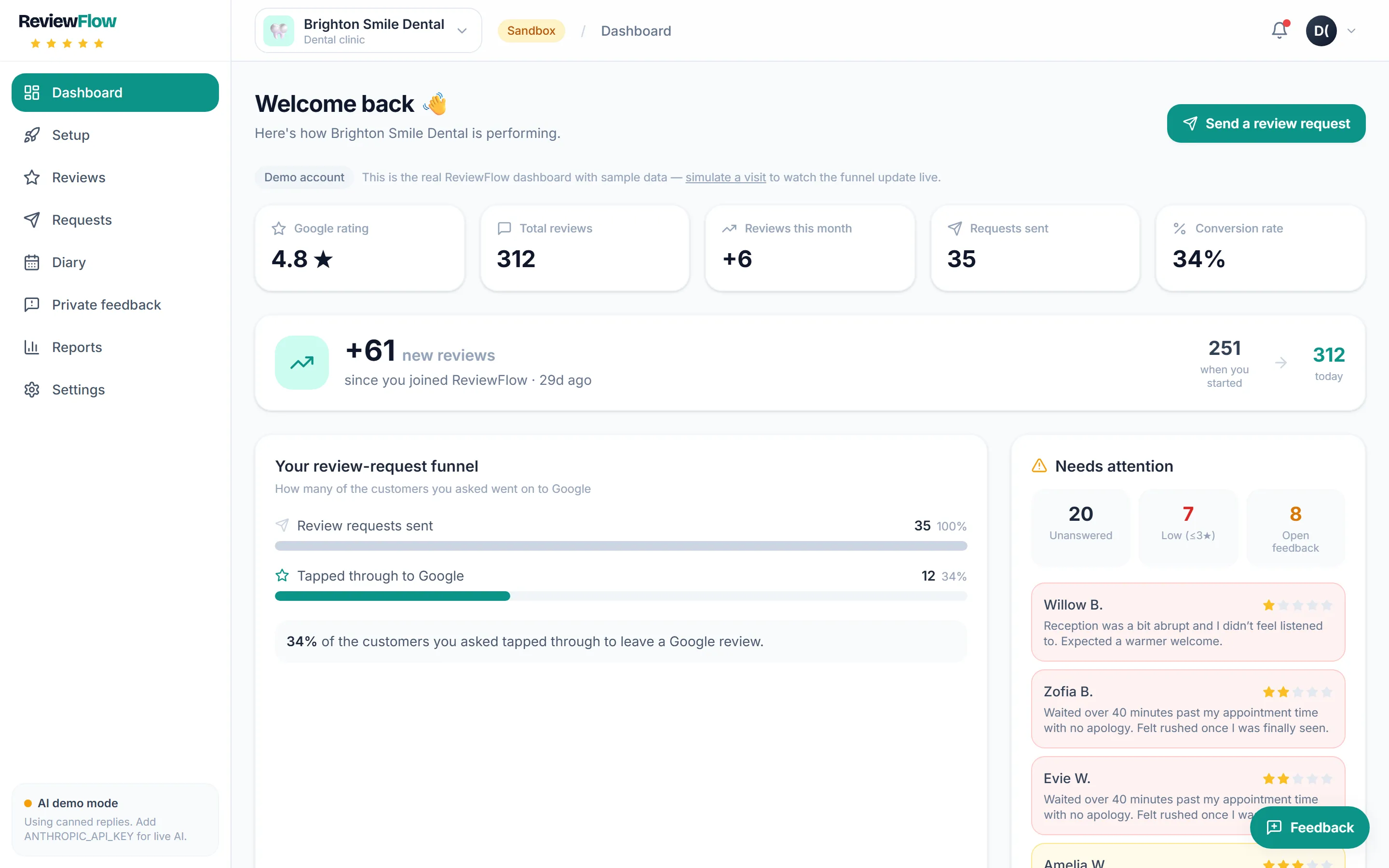
ReviewFlow lets a business add a customer, by hand, CSV, QR code or a walk-in prize wheel, and schedules a WhatsApp message with SMS fallback. Every customer gets the same two links: leave a Google review, or tell the manager privately. The original build had sentiment routing. I removed it, then commissioned a read-only audit of my own code that cited a file and line for every claim and labelled the things the code did not do as not found. It caught one leftover: the API still computed a rating-based routing value that nothing used. I removed that too.
- Data store
- Model or agent
- Check or gate
- Person
- External service
Consent is an append-only record storing the exact wording each person saw. Data subject requests are self-serve, and erasure anonymises in place while deliberately preserving the opt-out, because suppression has to survive deletion. The content security policy is all-self, fonts are self-hosted, logs are redacted, and the whole thing runs on one small machine in London for a few pounds a month.
Outcome
Deployed on a custom domain with over a hundred automated tests, an end-to-end run of 27 checks passed, and multiple security reviews with no exploitable findings. Twenty-three industry presets. Production WhatsApp sending awaits Meta business verification, and there are no paying customers yet, so I make no claims about volume.
What I’d do differently
Research the compliance position before building, not after; gating went in and came out. Ship a consent gate, not just a consent record, because evidence without enforcement is the first thing a regulator asks about. And start the third-party approvals on day one. Meta, Google Business Profile and Stripe approvals are multi-week lead times that gated launch long after the code was finished.
Recording
Screens
The choice screen. No routing by sentiment, by design and at the API level. Template editor with quiet hours and a single follow-up rule. Private feedback goes to the manager, never to Google. Inbox. Replies are drafted by the model and approved by a person. Self-serve data subject requests. Erasure anonymises in place and keeps the opt-out record. Walk-in capture. The page deliberately contains no review wording.