SetIQ
Drawing intelligence for main contractors. Upload a drawing issue and get the register, a plain-English changelog and answers with citations.
- Category
- Construction, AI platform
- Status
- Pilot
- Period
- Jul 2026
- Role
- Design, build, operate
- Link
- Demo site
- Stack
- Node.js 20Expressbetter-sqlite3pdf.jsAnthropic SDKClaude Haiku & SonnetReact 18ViteTailwind CSSDockernginx
Context
Every site team asks the same question when the architect re-issues drawings: what actually changed, and what did we miss? Document controllers rebuild registers by hand, and changes the architect never clouded are found on site, late. I spent years in construction project management, so this one is personal.
What I built
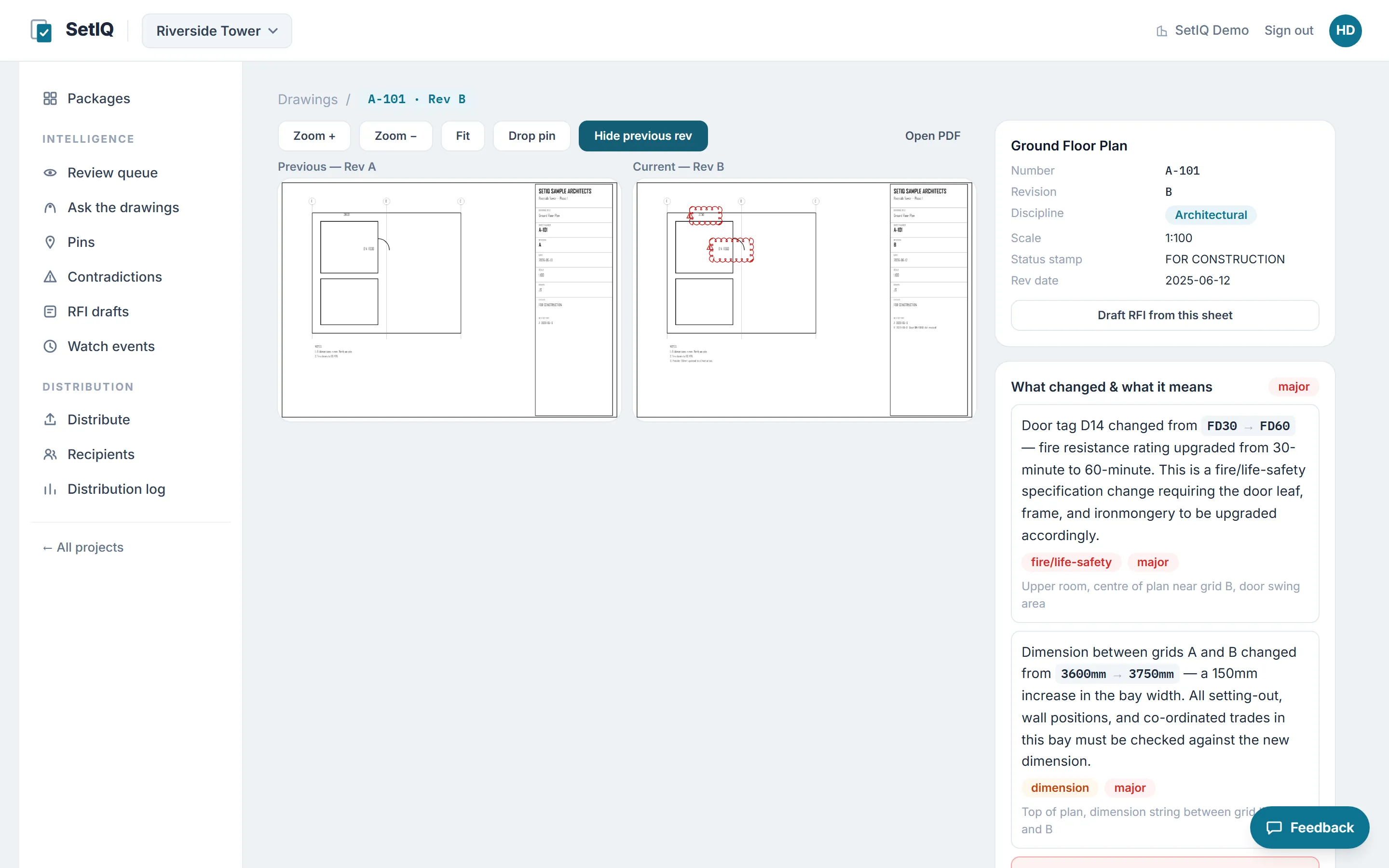
SetIQ takes a PDF drawing issue, renders each sheet, reads the title blocks with a vision model and builds the drawing register itself, working out which sheets supersede which across partial re-issues. Where a sheet has been revised it compares the two renders and writes a plain-English changelog with a category, a severity and whether the change was clouded. Unclouded changes are flagged as unannounced. Questions about the set are answered with citations to a sheet and revision, and the server drops any citation that was not among the retrieved sheets.
- Data store
- Model or agent
- Check or gate
- Person
A grounding check requires the extracted sheet number to appear in the page text; anything unsure goes to a review queue rather than being guessed. Every table carries a tenant identifier enforced at the repository layer, and every AI-generated artefact carries a note to verify before relying on it.
Outcome
A working multi-tenant application with 68 API endpoints, 19 screens, 22 passing tests, Docker packaging, a pilot handover document and a public demo site. Processing a three-issue sample set cost nine cents in model calls. It has not yet been run on a real client’s drawings.
What I’d do differently
Measure diff accuracy on real, messy drawing sets before polishing the interface; the evaluation harness exists but its fixtures are placeholders. Render title blocks at a higher resolution, since small-text misreads are visible in the demo. And make it responsive from the start. It is desktop-first and the register is unusable on a phone.
Screens
Sheet view. Two revisions side by side and what the change means on site. Changelog for an issue. Unclouded changes get their own band. The register, built from title blocks and supersession across issues. Questions are answered with citations, and citations are checked against what was retrieved.